Kaynes Technology: India's electronics bet, explained
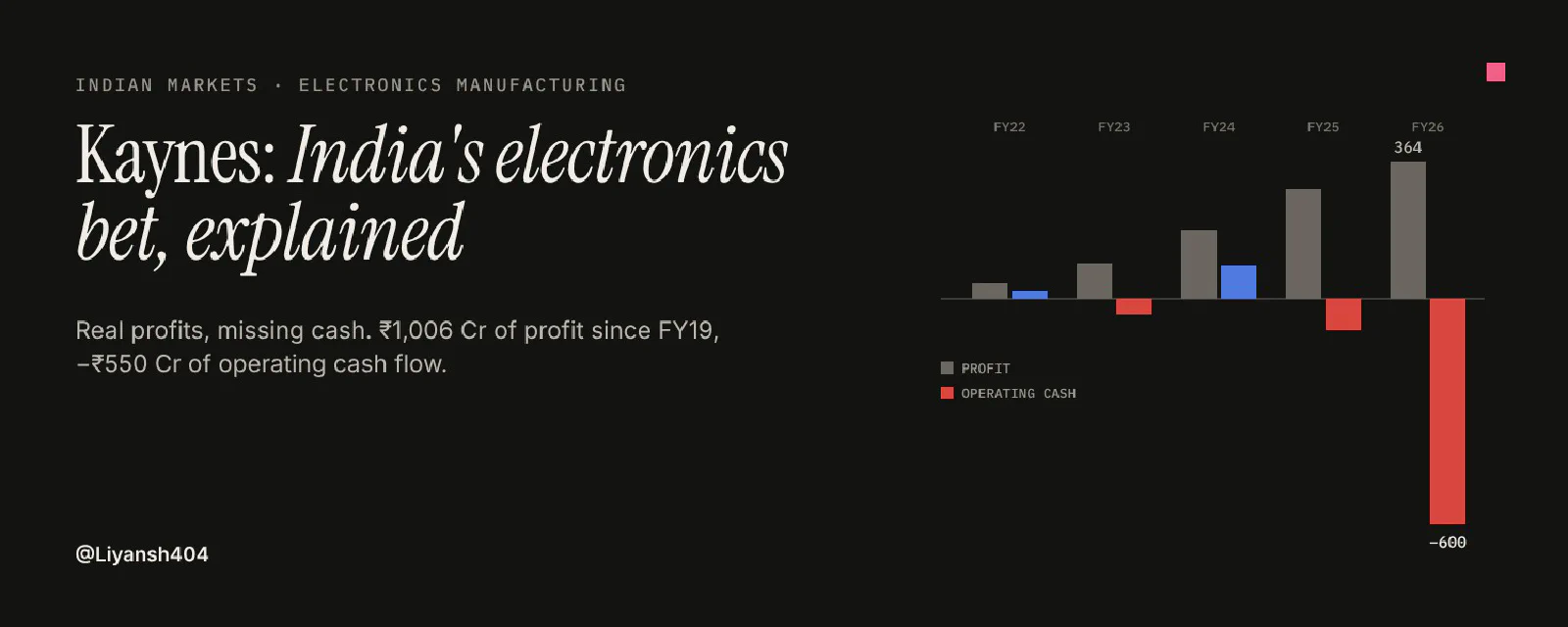
The profits are real, but the cash isn't showing up. The chip and PCB plants meant to fix that start earning only from late 2026.
In January 2025, Kaynes was the market’s favourite way to own India’s chip dream: a small-town electronics maker from Mysuru building one of India’s first chip-packaging plants. The stock traded at about 200 times earnings. Twenty-one months later it is down 53% from its 52-week high, after an accounting scare, a CEO exit, a promoter share sale and guidance missed again and again.
The short answer: the profits are real, but the cash isn’t showing up. Since FY19 Kaynes has reported ₹1,006 Cr of profit and −₹550 Cr of operating cash flow. Most of the gap sits in one business, smart meters. The chip and PCB plants that are meant to fix the story start earning only from late 2026.
The industry in two minutes
Every car, smart meter, train signal, missile and MRI machine has a circuit board inside. Most brands don’t make those boards themselves. They hire an EMS company (electronics manufacturing services) to buy the parts and assemble them. India’s version of this industry is growing fast.
- The boom is real, but mostly phones. Output reached ₹13.11 lakh Cr in FY26, up 15.8% (PIB). Phones are about 48% of it. The non-phone half, where Kaynes plays, grew only about 13% a year over FY24–26.
- Forecasts run ahead of reality. KPMG sees India’s EMS market going from $40–45 bn (FY25) to about $150 bn by FY30. That needs growth far above what the official data shows. CareEdge is more cautious at 16% a year.
- The government is paying for factories.
- Components scheme (ECMS): 106 projects approved worth ₹69,548 Cr. Kaynes won 4 of the first 7 approvals (₹3,280 Cr of planned investment in PCBs, camera modules and laminates).
- India Semiconductor Mission: pays 50% of a chip-packaging plant’s cost, plus state support. Kaynes’ plant in Sanand, Gujarat is one of only three mission units in production.
- Two business models.
- High-volume, low-mix (Dixon, Amber): make millions of phones or ACs at 4–7% margins, but get paid fast.
- High-mix, low-volume (Kaynes, Syrma, Avalon, Centum): make thousands of complex boards for cars, factories, defence and trains at 11–16% margins. They tie up far more cash in inventory and receivables.
What this means for Kaynes: demand is not the problem. The question is whether a high-mix model can grow at 30%+ without eating all its cash.
How Kaynes makes money
Think of Kaynes as a high-end tailor for electronics. It doesn’t sell its own brand. It takes a customer’s design (a car’s motor controller, a train’s safety system, a defence radar board), sources the parts and builds it. Each customer needs few units but exact quality, so Kaynes earns a 15–16% margin, roughly double a phone assembler’s.
The big bet is moving upstream. Instead of buying bare circuit boards and packaged chips, Kaynes wants to make them, with the government paying roughly half the factory cost. If it works, Kaynes captures more of each product’s value and becomes harder to replace.
Who the customers are:
- Automotive and EV: a quarter of revenue.
- Railways (Kavach safety systems): 6%.
- Aerospace and defence: only 2%, despite the story.
- Concentration: the top customer was 16% of FY25 revenue (FY26 deck).
- Order book: ₹8,904 Cr (Jun 2026), about 2.3 years of revenue, but barely growing for three quarters.
From Mysuru to semiconductors
Two things stand out:
- Kaynes is a capital raiser. Since its 2022 IPO it has raised about ₹3,660 Cr of fresh equity. Over FY23–FY26 its free cash flow was −₹3,267 Cr, roughly the same amount.
- The timing of the promoter’s sale hurts trust. On 4 Jun 2025 the founder sold 1.8% of the company for ₹625 Cr at about ₹5,551. Two weeks later the company raised ₹1,600 Cr from institutions at ₹5,570. The sale was legal and disclosed. Today the stock is at ₹3,250.
The moat and the competitors
Kaynes has the best margins in its peer group and the worst cash conversion. That combination is the whole debate.
| Company | Model | Market cap (₹ Cr) | P/E | Operating margin (TTM) | ROCE | ROE | Cash cycle (days) |
|---|---|---|---|---|---|---|---|
| Kaynes | High-mix | 21,847 | 62.9 | 15.6% | 12.7% | 8.7% | 193 |
| Syrma SGS | High-mix | 29,842 | 80.4 | 11.2% | 16.8% | 14.0% | 48 |
| Avalon | High-mix | 13,514 | 101 | 11.4% | 19.3% | 16.5% | 160 |
| Centum | High-mix | 5,883 | 67.3 | 11.8% | 25.5% | −12.5% | 234 |
| Dixon | High-volume | 74,016 | 39.4 | 3.6% | 29.2% | 18.9% | −7 |
| Amber | High-volume | 23,028 | 112 | 7.3% | 10.3% | 6.0% | 53 |
All figures from Screener.in, 20 Oct 2026.
Moat scorecard:
| Moat source | Rating | Why |
|---|---|---|
| Switching costs | Strong | Boards for cars, trains, defence and medical are qualified for years; customers rarely move them |
| Pricing power | Moderate | Highest margin among peers (~16%), but only kept by staying in niche, low-volume work |
| Technology and IP | Moderate | Design services plus early entry in chip packaging; little proprietary product |
| Scale | Weak | Revenue is under a tenth of Dixon’s, and smaller than Syrma’s |
| Customer concentration | Moderate | Top customer 16% of FY25 revenue |
Second-order: a high margin means little if the cash never arrives. Syrma earns 11% but collects in 48 days; Kaynes earns 16% but waits 193. Per rupee of capital, Syrma creates more value. That is why it trades at 80x while Kaynes trades at 63x.
Growth engines: the new plants
The market is paying for two factories that have not earned a rupee yet. Both are real, government-backed, and late.
| Engine | Capital | Status (Oct 2026) | Promised vs actual | Customers |
|---|---|---|---|---|
| Chip packaging (OSAT), Sanand | ₹3,307 Cr; ~₹1,830 Cr from central and Gujarat subsidies | Unit 1 (pilot) inaugurated 31 Mar 2026. Volume line due Q3 FY27 | Mass production promised by Jan 2026, then Jul 2026, now Q3 FY27 | Alpha & Omega Semiconductor (5-year offtake), Infineon, L&T Semiconductor |
| PCBs, Chennai | ~₹1,400 Cr phase 1; 4 ECMS approvals for ₹3,280 Cr of projects | ~₹500 Cr spent; plant not yet producing | Start promised Apr 2026, then Jul 2026, now Q2–Q3 FY27 | One global customer has issued a vendor code |
| Smart meters (GridCrest) | ~₹1,311 Cr of receivables tied up | Being shrunk; strategy due Feb 2027 | Collection of an acquired ₹350 Cr receivable promised “next quarter” from 2025; ~₹80 Cr done by May 2026 | State utilities (RDSS scheme) |
| Railway safety (Kavach) | Small | Still at trial orders | Trial completion promised mid-2025 | Indian Railways |
Revenue expected: management now guides ₹450–500 Cr from OSAT plus PCBs in FY27, all in the second half. In Feb 2026 it spoke of at least ₹1,500 Cr from OSAT and ₹1,000 Cr from PCBs by FY28; in May 2026 it said it had “not given any guidance like this”.
Will the new plants earn their cost of capital? Our estimate, at maturity around FY30–31:
- OSAT: about 14% pre-tax ROCE in the base case (range −2% to 38%). Without the subsidy it would be about 2%.
- PCBs: 12–17% in the base case.
- Breakeven: operating breakeven around FY28–29; cash payback around FY32–33.
The subsidy is what makes the economics work, so how fast it is paid matters as much as the factory itself.
Management: what they said vs what happened
We read seven earnings calls in full (Jan 2025 to Aug 2026), including the special call after the Kotak report in Dec 2025. The Feb 2026 call came from secondary transcripts, and we also used interviews and filings. The pattern is consistent: margins are delivered, and almost everything else (revenue, cash, dates) is missed.
How to read Kaynes’ guidance: cut revenue guidance by about 20%, accept margin guidance, add two quarters to any project date, and treat positive cash flow as unproven until two quarters show it. Management dropped numeric guidance in May 2026. It now says “twice the market” growth, about 15–18% plus the new plants.
What changed at the top:
- Leadership. CEO Rajesh Sharma resigned in Sep 2025. Dr Muthukumar Narayanaswamy (ex-Cummins Meritor) became MD. Founder Ramesh Kunhikannan is now Executive Vice Chairman.
- Departures. The deputy CFO, two company secretaries and two independent directors left. One independent director, on the audit committee, left three weeks before the Kotak report.
- The CFO went quiet. CFO Jairam Sampath missed the May 2026 call for health reasons and did not speak in August; the MD answered finance questions.
- The Kotak report. On 3 Dec 2025, Kotak Institutional Equities found that Kaynes’ FY25 standalone accounts omitted about ₹180 Cr of purchases between group companies and about ₹690 Cr of year-end balances. Kaynes called this “inadvertent”, said the consolidated accounts were correct, and did not restate.
- Auditor. K.P. Rao & Co. finished its first term; Walker Chandiok (Grant Thornton Bharat) took over from FY27, approved by 98.5% of votes at the Sep 2026 AGM. That is an upgrade.
- Pay is modest. Executive pay is about ₹7 Cr, about 1.9% of profit. No promoter shares are pledged.
Tone over time: bullish (Jan–Jul 2025), evasive (Nov 2025), defensive (Dec 2025), humbled (May 2026: management apologised for the FY26 miss), cautious (Aug 2026: “It is going to be a tough year”).
Latest call brief: Q1 FY27 (Aug 2026)
Call grade: CAUTIOUS.
| Signal | Status | What it means |
|---|---|---|
| Result quality | Weak | Sales +40% but profit −24%; EBITDA margin down 120 bp to 15.6% |
| Management tone | Hedged | No numeric guidance; “tough year”; smart-meter plan deferred to Feb 2027 |
| Guidance | Cut | OSAT + PCB FY27 revenue cut to ₹450–500 Cr; dates pushed a quarter |
Why profit fell while sales rose:
| Driver | Effect on profit vs Q1 FY26 |
|---|---|
| Higher EBITDA | Up ₹35 Cr (material costs rose to 65.6% of sales from ~58.7%) |
| Depreciation (new plants) | Down ₹21 Cr (+137%) |
| Other income (QIP cash spent) | Down ₹13 Cr (−47%) |
| Interest | Down ₹9 Cr |
| Tax rate 22% → 36% | Down ₹10 Cr |
At the old tax rate, profit would have fallen about 8%, not 24%. The standalone parent earned ₹76.9 Cr against ₹56.4 Cr consolidated, so the subsidiaries (new plants, meters) cost about ₹20 Cr in the quarter.
Financials: real profits, missing cash
Kaynes grew revenue nearly 9x in five years and kept margins at 15–16%. But almost none of that profit turned into cash. The gap widened sharply in FY26.
Where the cash went (FY26):
- Receivables: up 166% while revenue grew 33%. Debtor days doubled from 77 to 154, or about 178 including long-dated meter receivables.
- Smart meters: about ₹1,300 Cr of receivables on ₹971 Cr of revenue, roughly 15 months of sales. Core EMS collects in about 55 days.
- Factories: ₹1,240 Cr of capex, mostly the new plants.
- Who paid: the June 2025 ₹1,600 Cr equity raise. Debt stayed flat at about ₹900 Cr.
Profit and loss, actuals and our estimates (₹ Cr; actuals from Screener)
| FY24 | FY25 | FY26 | FY27E | FY28E | |
|---|---|---|---|---|---|
| Revenue | 1,805 | 2,722 | 3,626 | ~4,500 | ~5,575 |
| EBITDA | 257 | 416 | 578 | ~700 | ~890 |
| EBITDA margin | 14% | 15% | 16% | ~15.5% | ~16% |
| Net profit | 183 | 293 | 364 | ~290 | ~380 |
| EPS (₹) | 28.68 | 45.80 | 54.28 | ~43 | ~57 |
| Consensus EPS (₹) | 57.88 | 88.31 | |||
| Operating cash flow | 88 | −82 | −600 | ||
| ROCE | 14% | 13% | 13% (Screener: 12.7%) |
Our estimates are below consensus. Depreciation and interest from the new plants arrive before their revenue. The tax rate is running at 34–36%, and treasury income falls as the raised cash is spent.
Earnings quality checklist
| Test | Rating | Evidence |
|---|---|---|
| Receivables vs revenue growth | Red | Receivables +166% vs revenue +33% (FY26) |
| Cash conversion cycle | Red | 102 days (FY25) to 193 days (FY26); 70–85 days was promised |
| Revenue recognition | Amber | Meter revenue booked well ahead of collection; no auditor qualification |
| Related-party disclosure | Amber | FY25 standalone omissions admitted; no transactions with promoter-owned companies found in H2 FY26 |
| Contingent liabilities | Amber | ₹520 Cr (18% of net worth) in FY25, plus ~₹2,180 Cr of guarantees to subsidiaries in H2 FY26 |
| Other income share of pre-tax profit | Amber | 31% in FY26 (interest on raised cash), falling to 16% in Q1 FY27 |
| Tax rate | Amber | 21% to 34–36%; explained by loss-making subsidiaries and non-deductible items |
| Capitalised costs | Amber | Intangibles up from ₹224 Cr to ₹520 Cr; intra-group interest capitalised at the new plants |
| Auditor | Amber, improving | Smaller first-term auditor replaced by Walker Chandiok from FY27 |
| Goodwill | Green | Only ₹16 Cr |
Verdict: amber leaning red. There is no proof the profits are fake. The problem is cash, concentrated in smart meters, plus a disclosure record that has cost management the benefit of the doubt.
Valuation: what are you paying for?
Valuation verdict (our model): OVERVALUED. Our fair value is ₹1,900–2,350 a share, against ₹3,250 today. On cash flows the stock is priced well above what the business currently earns. The market is paying for the chip-plant option and a cash turnaround that has not yet happened.
Step 1: the de-rating is done, but the multiple is still high. Since IPO the share price has risen about 5.5x, almost exactly in line with EPS. All the 2024–25 multiple expansion has reversed.
Step 2: methodology
- Business type: high-growth, high-mix EMS in a heavy capex phase, with government-subsidised semiconductor plants.
- Primary method (70% weight): forward P/E on FY28 earnings. Earnings are positive and the market prices this sector on P/E; FY28 is the first year the new plants should contribute.
- Secondary method (30%): DCF on free cash flow. This is the only method that captures Kaynes’ working-capital problem, which is the core issue.
- Rejected:
- P/BV: book value is swollen by recent equity raises.
- EV/sales: ignores the margin and cash differences that separate Kaynes from peers.
Step 3: key assumptions
| Assumption | Value | Basis |
|---|---|---|
| FY28E EPS | ₹57 (consensus ₹88) | Revenue ~₹5,575 Cr, EBITDA 16%, higher depreciation and interest from new plants, 30% tax |
| Target P/E | 40–50x (base 45x) | Below high-mix peers (67–101x) given 8.7% ROE and governance history; above Dixon (39x) for growth |
| DCF WACC | 13.5% | 7% risk-free + 1.1 beta × 5.5% premium + governance premium |
| Revenue growth (DCF) | 24% FY27–28, fading to 8% by FY36 | Above management’s “2x market” guide, to give credit for the new plants |
| EBITDA margin (DCF) | 15.5% rising to 17% | FY26 was 15.9% |
| Working capital | 36% of revenue falling to 18% by FY29 | FY26 was ~36%; 18% assumes smart meters shrink and core EMS stays at ~55 days |
| Capex | ₹850 Cr (FY27), ₹700 Cr, ₹500 Cr, ₹450 Cr, then 4% of revenue | Management’s FY27 plan, net of subsidy |
| Terminal growth | 6% | India nominal GDP |
| Shares / net debt | 6.72 crore / ₹115 Cr | Screener |
Step 4: the numbers
- P/E method: ₹57 × 45 = ₹2,565 (range ₹2,280–2,850).
- DCF: ₹1,093 (range ₹861–1,489). About 70% of DCF value is in the terminal value, and working capital eats most of the cash in the first three years.
- Blended (70/30): ₹2,125, band ₹1,900–2,350.
What you have to believe to pay ₹3,250: FY28 EPS of about ₹72 at 45x, or the full consensus ₹88 at 37x. That needs the new plants on time, smart-meter cash collected, and the tax rate back near 25%. Our reverse DCF needs about 30–45% revenue growth a year for five years just to reach ₹1,700–2,500.
Bear, base, bull (value around mid-2028, FY28 EPS × P/E, before dividends)
| Case | What happens | FY28 EPS | P/E | Value | vs ₹3,250 |
|---|---|---|---|---|---|
| Bear | Plants slip again, meter write-downs, more dilution | ₹40 | 35x | ₹1,400 | −57% |
| Base | Plants ramp in H2 FY27, meters shrink slowly, tax stays high | ₹57 | 45x | ₹2,565 | −21% |
| Bull | Consensus delivered, cash turns positive, chip plant wins new customers | ₹88 | 50x | ₹4,400 | +35% |
Where the street stands: 23 analysts, average rating Hold, average target ₹3,715 (range ₹2,790–5,000). After Q1 FY27, only Motilal Oswal (₹5,000) and Jefferies (₹4,480) said Buy. JPMorgan, CLSA, Nomura, JM, Nuvama and Equirus were Neutral, Hold or Reduce. FY27 consensus EPS has already fallen about 55% since Dec 2025. Our numbers are lower because we expect more cuts.
Our model is deliberately strict on cash. If working capital falls to Syrma-like levels (~48 days) and the plants hit management’s targets, value rises sharply. That is the bull case.
Risks
Downside risks:
- Cash burn and dilution.
- Q1 FY27 operating cash flow was −₹259 Cr, and FY27 capex is about ₹850 Cr.
- A reported $1 bn chip-plant expansion is on the table.
- Without fast collections, another equity raise is likely.
- Probability: high; impact: high. Monitor half-year cash flow (Nov 2026).
- Smart-meter dues.
- ₹1,311 Cr is owed by state utilities, about 28% of net worth.
- Only ₹88 Cr was collected in Q1 against about ₹240 Cr billed.
- Probability: medium; impact: high. Monitor the Feb 2027 strategy update.
- More earnings cuts. Consensus FY27 EPS of ₹58 needs the next three quarters to beat last year by about 15%, after a 24% fall in Q1. Probability: high; impact: medium-high.
- Plant delays. Both new plants have slipped two or three times already. Probability: high; impact: medium.
- Disclosure. CRISIL lists “further disclosure lapses or adverse auditor observations” as a trigger. The new auditor’s first full-year report (FY27) is the test. Probability: low-medium; impact: high.
Upside risks (things that could prove us wrong):
- The chip plant wins a large customer. It could sign a big multinational or win an anchor order beyond Alpha & Omega and Infineon.
- Smart meters are sold or spun off. That would release most of the ₹1,300 Cr of tied-up cash.
- The cash cycle normalises. If debtor days fall back toward 90–100, cash flow turns positive and the stock re-rates toward high-mix peers at 80–100x.
- Core EMS keeps growing fast. It grew 48–53% in Q1 FY27 and collects its cash.
Conclusion
Kaynes is a real business with a real edge: high-margin, hard-to-switch electronics work, and one of India’s first chip-packaging plants, half paid for by the government. The core EMS business grew about 50% in Q1 FY27 and collects its cash.
But the company grew faster than its cash, then bought a smart-meter business whose customers don’t pay. Promises on revenue, cash and dates have been missed again and again. Disclosure slips cost it the market’s trust. At ₹3,250 and 63x trailing earnings, the stock still prices in a turnaround that has not started.
In one line: a good factory story attached to a bad cash story, still priced for the good one.
Bottom line (research, not investment advice):
- Valuation verdict: overvalued; fair value ₹1,900–2,350 (blended P/E and DCF).
- Base case: value around mid-2028 of ₹2,565, about 21% below today.
- Who the story suits: only someone who believes the chip plant becomes a national champion and can sit through more dilution. Not for anyone who needs cash-backed earnings.
What would prove this view wrong (thesis invalidation triggers):
- Operating cash flow turns positive for two quarters in a row, and debtor days fall below 110.
- OSAT and PCB plants book at least ₹450 Cr of revenue in H2 FY27 at positive EBITDA.
- The smart-meter business is sold or restructured in a way that releases at least ₹800 Cr of cash.
The 60-second version: Q1 FY27 looked like 40% growth but was a 24% profit fall, driven by new-plant depreciation, lost treasury income and a 36% tax rate; at the old tax rate it was about −8%. Core EMS is healthy: it grew about 50%, earns ~16% margins and collects in ~55 days. The damage is smart meters, with ₹1,311 Cr of unpaid bills on ₹971 Cr of revenue, plus ₹850 Cr of capex this year. The multi-bagger case rests on the Sanand chip plant and the Chennai PCB plant, both about 55% subsidised and both starting revenue in Q3 FY27, at least two quarters late. The next catalyst is the H1 cash-flow statement with Q2 results. The biggest risk is another equity raise at these prices. Our fair value is ₹1,900–2,350; two quarters of positive cash flow would make us revisit it.
What to track
Q2 FY27 results (due by 14 Nov 2026):
- Cash flow. H1 operating cash flow, and whether the “70–80% reduction in negative cash flow by Q3” is on track.
- Smart-meter collections vs billings; any write-down.
- Plant timelines. First revenue from Sanand Unit 2 and the Chennai PCB plant.
- Margins and tax. Gross margin (material costs were 65.6% of sales in Q1) and whether the tax rate eases from 36%.
- Order book above ₹8,904 Cr, and new wins in auto, aerospace and railways.
- Funding. Any talk of a new equity raise or the $1 bn chip expansion.
Later:
- Smart-meter strategy at the Feb 2027 results (around 15 Feb 2027)
- OSAT subsidy received beyond ₹170 Cr
- The new auditor’s first full-year report (FY27)
- CRISIL rating review
How this was researched
We ran seven research tracks in parallel: forensics, two sets of earnings calls, management, growth engines, industry, and brokers with the bear case. An independent fact-checker then re-verified 13 key claims against primary sources. Financial figures for Kaynes and peers come from Screener.in (fetched 20 Oct 2026, price as of 19 Oct close). The valuation models and estimates are ours.
Limits:
- TV interviews (CNBC-TV18, ET Now) were not available as transcripts.
- The financial notes in the FY25 and FY26 annual reports could not be fully opened, so receivables ageing and the FY26 contingent-liability total are unverified.
- The Feb 2026 call came from secondary transcripts.
Main sources:
- Screener.in: Kaynes consolidated
- Kaynes calls and decks:
- Kaynes clarification on the Kotak report
- Monitoring agency report on QIP funds, Q1 FY27
- CRISIL rating rationale (12 Mar 2026)
- MarketScreener consensus
- PIB: India electronics production
- Business Standard: brokerages split after the analyst meet
- Value Research: Kaynes down 61%, still not a clear buy
Data as of 20 Oct 2026 (prices as of 19 Oct close). This is research, not a recommendation to buy or sell; do your own research.