Acutaas Chemicals: a great business riding one drug
One cancer drug turned a Surat chemicals maker into a ₹26,000 Cr company. The core keeps beating guidance, the new ventures keep slipping, and the price already assumes a near-perfect decade.
The story in one minute
Acutaas Chemicals, formerly Ami Organics, is a Surat company that makes the chemical building blocks of medicines. In FY21 it sold ₹341 Cr of mostly generic drug intermediates. In FY26 it sold ₹1,339 Cr at a 36% EBITDA margin, and the stock is up about five times in three years.
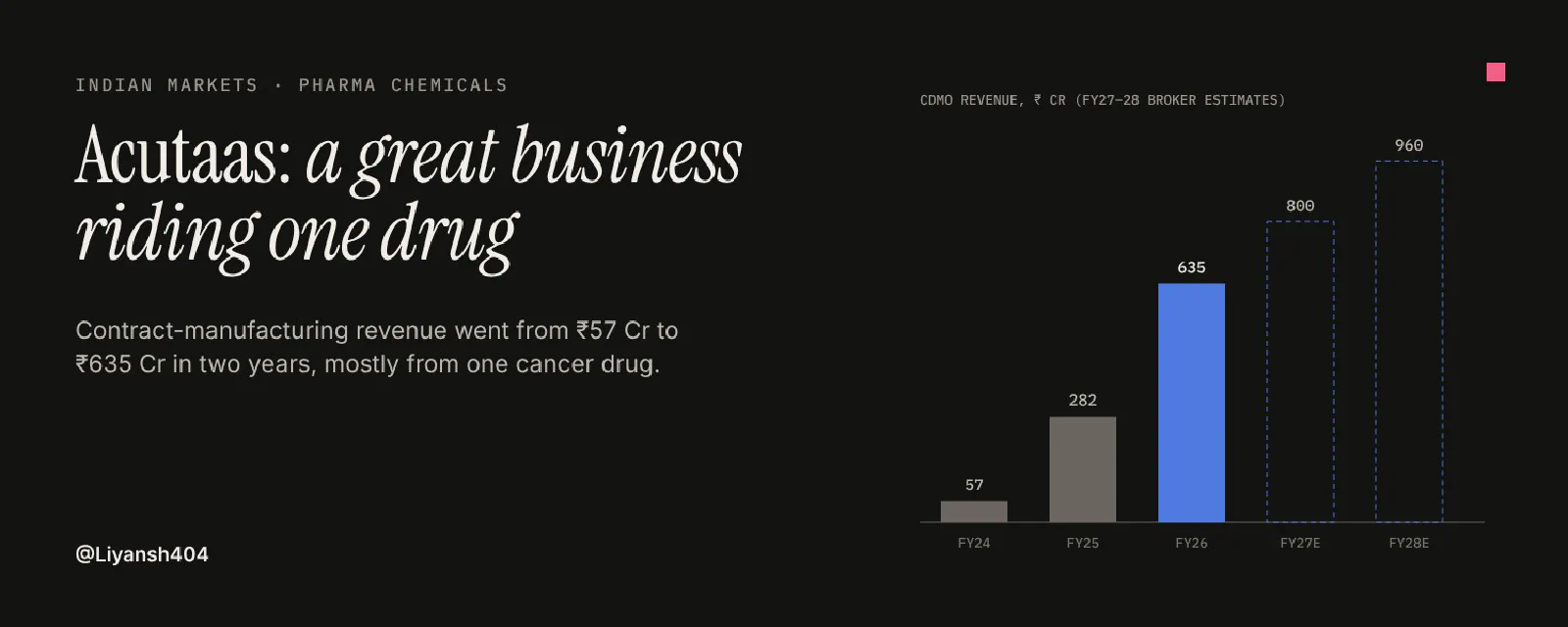
Most of that jump came from one customer and one drug. Acutaas makes five intermediates for Fermion, the drug-ingredient arm of Finland’s Orion. Fermion turns them into darolutamide, which Bayer sells as Nubeqa for prostate cancer. Nubeqa’s sales went from €869m in 2023 to about €2.4bn in 2025 and are now running at about €3.5bn a year. Acutaas’s contract-manufacturing (CDMO) revenue went from about ₹57 Cr to ₹635 Cr in two years.
So the investor’s questions are simple:
- How long can the Nubeqa engine keep running?
- What else is coming: four new CDMO drugs, battery chemicals and chip chemicals?
- How much of all that is already in a price of ₹3,152?
Where we land: a very good business priced for a near-perfect decade. The core pharma business keeps beating its own guidance. Every new venture so far has arrived late or smaller than promised. Our blended fair value is ₹2,050 to ₹2,450, about 28% below today’s price at the midpoint. The details and the maths are below; the conclusion is at the end.
Disclosure: shares of Acutaas Chemicals are held in my family portfolio, so read this with that bias in mind. This is research, not a recommendation to buy or sell.
What Acutaas actually makes
A medicine’s active ingredient (the API) is built in many chemical steps. Each step’s output is an “intermediate”. Acutaas makes the advanced intermediates, usually the last few steps before the API, and sells them to the companies that finish the API. It sells about 610 products to about 600 customers in 55 countries. About 76% of revenue is exports.
There are three ways it earns money from this:
- Generic intermediates. Acutaas owns the process and sells to many generic drug makers. It claims 50–90% global share in some molecules: dolutegravir (HIV), trazodone (depression), entacapone (Parkinson’s), apixaban and rivaroxaban (blood thinners). It is good business, but Chinese suppliers can and do cut prices.
- Innovator supply and CDMO. Acutaas makes intermediates for a patented drug under a long contract. The customer owns the drug. This is where the money is now.
- Specialty chemicals. Parabens and methyl salicylate (an old, low-margin business being wound down), photoresist chemicals for chips, and from FY27, battery electrolyte additives.
The plants
| Site | What it makes | Size | Use, Q1 FY27 |
|---|---|---|---|
| Sachin, Surat | Pharma intermediates; USFDA and Japan PMDA inspected | 144 KL | 83%, “hitting the roof” |
| Ankleshwar | CDMO blocks, including the Nubeqa intermediates | 442 KL | 23% |
| Jhagadia | Commodity chemicals; battery additives (2,000 t VC + 2,000 t FEC) | 512 KL + battery block | 55% |
| Greater Noida | Photoresist chemicals (Baba Fine Chemicals, 55% owned) | 1.8 KL | n/a |
| Gongju, South Korea | Chip chemicals (Indichem, 75% owned); opened 28 Aug 2026 | 16,513 sq m site | Not yet producing |
Two things stand out. Sachin is nearly full, so pharma growth will need the new land the company is buying. Ankleshwar, built for CDMO, is only a quarter used. That spare room is what lets the next CDMO products ramp up without much new money.
The industry: a good place to be, at a full price
Pharma outsourcing is growing faster in India than anywhere else. Frost & Sullivan (cited in Anthem’s IPO papers) sizes India’s contract research and manufacturing market at about US$8.2bn in 2024, growing about 13% a year to US$15.4bn by 2029. The global market grows 8–9%. ICRA uses a narrower definition (US$3.4–4.0bn) but sees similar growth of 15–16% a year.
Three things are pushing work to India:
- China+1. Big drug companies are moving development work out of China, slowly. The US BIOSECURE Act became law in December 2025, but its bans on Chinese suppliers likely start only around 2028, and existing contracts are protected for years after that. It helps sentiment now, revenue later.
- Biotech money is back. Biotech funding rose for four straight quarters to mid-2026. CDMO orders usually follow with a 6–9 month lag.
- US tariffs spare generics so far. The April 2026 Section 232 tariffs hit patented drugs, not generics, though the generic exemption comes up for review around April 2027.
Two things push the other way:
- Orders are lumpy. In Q1 FY27, Anthem’s revenue fell 29%, Cohance’s 23% and Blue Jet’s 17%, all from shipment timing and customer destocking. Acutaas’s own revenue fell 24% from the previous quarter.
- China still sets generic prices. In September 2025 Chinese makers cut prices on 41 drug ingredients by 40–50%. Acutaas’s generic book has no long-term contracts to protect it.
Peers in Q1 FY27
| Company | What it does | Q1 FY27 | P/E |
|---|---|---|---|
| Divi’s | Largest Indian API and custom-synthesis player | Revenue +28%; custom synthesis +45% | 81.9x |
| Neuland | Generic APIs plus custom manufacturing; about 3 molecules drive it | Total income +116% | 48.9x |
| Laurus | HIV generics plus CDMO (41% of revenue) | Revenue +29%; CDMO +70% | 99.4x |
| Sai Life | Pure-play contract research and manufacturing | Revenue +12% | 80.5x |
| Anthem | Contract research and manufacturing | Revenue −29% (shipment delays) | 76.5x |
| Aarti Pharmalabs | Xanthines, APIs, small CDMO | Revenue +39% | 35.5x |
| Acutaas | Advanced intermediates plus one large CDMO contract | Revenue +59% | 66.8x |
Acutaas grew faster than everyone except Neuland. Only Neuland and Navin Fluorine’s CDMO arm matched its margin. The market prices it below Divi’s, Sai Life and Anthem because it is smaller and depends on one product.
The other two businesses sit in harder markets:
- Specialty chemicals are in a slump. CRISIL expects sector revenue to grow only about 6% this year, with margins down 1.5–2 points, because Chinese dumping caps prices. Acutaas’s parabens business is exactly this kind of product.
- Battery additives are a cyclical commodity with a short-term tailwind. China makes most of the world’s vinylene carbonate (VC). Its price collapsed from about 475,000 yuan per tonne in 2021 to 46,000 in 2025, then jumped back above 200,000 in July 2026 after a new Chinese battery-safety rule. Acutaas is India’s only listed maker of these additives. Neogen, GFL and Tatva Chintan make lithium salts and electrolyte instead, so they could be customers rather than rivals.
Weighted by Acutaas’s revenue, the score is about 3.8 out of 5: a good neighbourhood. But the Nifty Pharma index trades at 39.6x earnings, 13% above its 10-year median, so the whole sector is already priced well.
The customers, and what they are doing
Acutaas rarely names its customers. Brokers, deal announcements and the customers’ own reports fill most of the gaps. The picture: one customer drives the growth today, a group of generic drug makers gives a steady base, and the next wave of customers (four drug originators and some battery makers) has signed up but not yet started paying much.
1. Fermion, Orion and Bayer: the Nubeqa engine
Acutaas has supplied Fermion for over a decade. The big change came in November 2022: a 10-year, “multi-tonne” contract for an intermediate of a patented drug, widened in September and December 2023. The company never names the drug. Two brokers (Prabhudas Lilladher and Value Research) say it is darolutamide, and management did not deny it when asked on the July 2026 call. About a third of the Ankleshwar plant is dedicated to it.
The drug is doing very well:
- Sales: €869m (2023) to €1,523m (2024) to about €2.4bn (2025). In the first half of 2026 sales grew 61%.
- New uses: the US FDA approved a third use, for advanced prostate cancer without chemotherapy (ARANOTE), in June 2025. Two more large trials are running, with new approvals expected around 2028.
- Orion’s outlook: Orion raised its 2026 guidance in July on higher Nubeqa royalties and says its own Nubeqa income could pass €1bn a year by about 2030.
What this did to Acutaas (broker estimates, because the company stopped disclosing the split):
If “the majority” of CDMO is Fermion, the Nubeqa intermediates were roughly ₹380–540 Cr, or 28–40% of FY26 revenue. At the IPO in 2021, the top customer was 16%. Kotak downgraded the stock to REDUCE in July 2026 for exactly this reason.
Three things to know about this engine:
- It will slow. Acutaas’s CDMO revenue grew 125% in FY26 while Nubeqa grew 57%, because Acutaas added more intermediates and customers built stock. From here, Acutaas’s growth should move toward Nubeqa’s volume growth, roughly 15–30% a year and falling.
- It is lumpy. Orion says Fermion’s 2026 deliveries are driven by “timing” and should “level out during H2/2026”. Acutaas management plans on purchase orders, not on Bayer’s sales forecasts. A 10% swing in Fermion orders moves Acutaas revenue by about ₹40–55 Cr.
- It has an end date. Patents expire between 2029 (UK) and 2035 (big EU markets); the US is about 2033. Alembic is already in a US patent fight to launch a generic. After expiry, generic darolutamide makers will still need intermediates, so volume may survive, but the exclusive position and its pricing will not.
The next data point is Orion’s Q3 report on 28 October 2026.
2. Generic drug makers: the steady base
About half of pharma revenue comes from generic intermediates sold to many API makers. Named customers over the years include Laurus, Zydus and Cipla (IPO documents) and GSK, Sun Pharma and Dr Reddy’s (Value Research). The molecules matter more than the names:
- Apixaban (Eliquis): generics launched in Europe in May 2026; US generics are blocked until April 2028. Management says apixaban “has already started picking up”. JM Financial puts the opportunity at about ₹440 Cr.
- Rivaroxaban (Xarelto): US generics launched in 2025 with prices down about 90%. That means more volume for intermediate makers, at lower prices.
- Lumateperone (Caplyta): Acutaas has a process patent on one intermediate and is qualified with three generic makers, waiting for launch.
- Older molecules (dolutegravir, trazodone, entacapone): high market shares, mature demand, and exposed to Chinese price cuts.
3. Four new drug originators: the next CDMO wave
Four more CDMO products have been validated with “originators”. JM Financial says they are in heart disease and cancer. They are waiting for the customers’ drug approvals.
- Size: management says each is worth ₹50–100 Cr a year at peak, so ₹200–400 Cr in total. JM models ₹320 Cr by FY30.
- Timing: revenue starts in H2 FY27, with the main ramp in FY28.
- Why it matters: this is the main way concentration on Nubeqa falls. Management targets ₹1,000 Cr of CDMO revenue by FY28 and says it will “meet or beat” it.
- Track record: a second CDMO project was first promised for Q4 FY25 and slipped four times.
4. Battery makers in North America and Korea
- Customers: none named. Management says they are several cell makers in North America, Korea and other regions, and that no single customer dominates.
- Contracts: the whole 4,000-tonne capacity is sold for three years at fixed prices, with raw-material and currency costs passed through.
- Demand: management calls it “unprecedented”, and sales are limited by plant capacity. Supply started in Q1 FY27, but revenue has not been disclosed.
- The partner that never came: in 2023–24 Acutaas planned a joint venture to make electrolyte with “one of the largest electrolyte makers in the world”. This was almost certainly Korea’s Enchem, but the joint venture never got outside money. The October 2026 “acquisition of Enchem Ami Organics for ₹1 lakh” was only a transfer of an empty subsidiary inside the group. Enchem itself is now in trouble: its auditor has flagged doubt about whether it can keep operating, and it is turning to Chinese energy-storage customers such as CATL.
- A new partner: in May 2026, Acutaas gave 10% of its battery subsidiary to A.R.Z Pharma of Israel, its long-time marketing agent for these products.
5. Chip makers
- Baba Fine Chemicals: once served one main customer, a US partner linked to Heraeus. Revenue was about ₹47 Cr before the 2023 deal and only ₹15.7 Cr in FY26, against a promised ₹200–250 Cr. It recovered from Q4 FY26.
- Indichem (Korea): sending samples to customers in Korea, Japan and Taiwan. No supply contract has been disclosed. Revenue is expected from FY28.
The customer-led growth story, in one table
| Engine | Customer signal | Revenue potential | When | Confidence |
|---|---|---|---|---|
| Nubeqa intermediates | Bayer sales +61%; Orion raising guidance | Grows with Nubeqa volume; about ₹400–700 Cr | Now to about 2033 | High near term, falling after 2030 |
| Four new CDMO drugs | Validated, waiting for approvals | ₹200–400 Cr at peak | H2 FY27 to FY30 | Medium |
| Apixaban and other generics | EU generics live; US from 2028 | About ₹440 Cr opportunity (JM) | FY27 to FY30 | Medium; prices fall |
| Battery additives (VC, FEC) | 3-year contracts; China VC price up 4x | ₹250–420 Cr at full use (our estimate) | FY27 to FY29 | Medium-low; past delays |
| Chip chemicals | Samples only | About ₹200 Cr at full Indichem capacity (our estimate) | FY28 to FY31 | Low |
Add it up and a path to about ₹3,000 Cr of revenue by FY30 is believable, roughly double FY26’s run-rate. That is the bull case. The risk is that one engine (Nubeqa) is doing most of the work while the others are still unproven.
Management and capital allocation
Who runs it. The company was started in 2004 by Nareshkumar Patel, a chemical engineer and now Chairman and Managing Director, with Chetan Vaghasia, who runs operations. They own 17.7% and 15.0%. Bhavin Shah has been CFO since 2022. Abhishek Patel, VP Strategy, gives most of the guidance on calls. There have been no CEO or CFO changes since 2023. The board has four executive and four independent directors. The auditor is Maheshwari & Co., a mid-sized regional firm, reappointed to FY29. The Chairman was paid ₹6.4 Cr in FY26, about 2% of profit.
How the stake changed. The promoters’ share fell from 39.9% to 32.7% in two steps. Only the second step was a sale:
- 2024, dilution: a ₹99 Cr preferential issue and a ₹400 Cr QIP, both at ₹1,240 before the share split. The promoters sold nothing. The QIP money was spent as promised: ₹250 Cr repaid debt, ₹50 Cr went to capex and solar, and ₹88 Cr to general purposes. There were no deviations. The company has been debt-free since May 2025.
- May 2025, a sale: the two founders sold ₹301 Cr of shares at ₹1,115 to Kotak Mutual Fund, about 3.3% of the company. The stock is now 2.8 times that price. Some press reports said 6.6%; that used the pre-split share count and is wrong.
- Since then: the promoters have held steady with no pledges. Foreign funds rose from 17% to 23%.
Capital allocation scorecard
| Decision | Money | What happened | Verdict |
|---|---|---|---|
| Bought Gujarat Organics’ Ankleshwar and Jhagadia units (2021) | ₹93 Cr | Ankleshwar now hosts the Nubeqa CDMO blocks; Jhagadia hosts the battery plant | Excellent |
| QIP and preferential issue (2024) | ₹500 Cr raised | Debt repaid, net cash ₹314 Cr today | Good |
| Fermion contracts and Ankleshwar CDMO blocks (2022–25) | Part of ₹500 Cr+ capex | CDMO revenue from ₹57 Cr to about ₹635 Cr | Excellent |
| US drug-discovery JV with Photolitec | ₹32 Cr | Written off in full in Sep 2023 (“drug discovery is not a cup of tea for Ami Organics”) | Poor |
| Baba Fine Chemicals, 55% (2023) | ₹68 Cr | Revenue fell from ₹47 Cr before the deal to ₹16 Cr; ₹200–250 Cr target missed | Poor so far |
| Battery additives plant | About ₹220 Cr | Built at full capacity, but about two years late; returns not yet visible | Pending |
| Indichem, Korea (2025–26) | About ₹200 Cr | Plant opened Aug 2026; revenue from FY28 | Pending |
Capital allocation grade: B.
- The good: the core pharma money has been very well spent. Equity raised in 2024 was used exactly as promised, and the balance sheet is clean.
- The bad: every venture outside pharma so far has been written off, has shrunk or is late. The two biggest open bets, about ₹420 Cr on batteries and Korea, are still unproven.
- Governance signals to watch:
- At the September 2026 AGM, shareholders voted down an ESOP plan for subsidiary staff: 72.6% in favour against the 75% needed, with institutions 58% against.
- In December 2025, options were granted at ₹305 when the stock was about ₹1,670.
- Tax officers searched the head office and Sachin plant on 22–23 June 2026. No demand has been disclosed yet.
What the FY26 annual report says
We read the 270-page FY26 annual report (dated 29 August 2026): the letters, the segment pages, the auditor’s report and the notes.
The one thing that matters: this was the best year in the company’s history, and the numbers behind it are clean. Revenue rose 33%, EBITDA 107% and profit 122%. The auditor’s opinion is unmodified, with no qualifications and no “emphasis of matter”. The only key audit matter is how inventory is valued. Customers pay on time. The weak spots are not in the accounts; they are in where the money is going next.
Six things a quick reader would miss:
- Receivables are clean. Of ₹364 Cr owed by customers, 84% was not yet due at year end, and only ₹4 Cr was more than six months overdue. Bad-debt provisions are just ₹1.6 Cr.
- A lot of money is waiting to earn. Capital work in progress jumped from ₹130 Cr to ₹332 Cr (mostly the battery plant and Korea). Until those plants make money, they drag on return on capital.
- The ROCE headline is flattering. The report says “highest-ever RoCE of 39.3%”, but that figure leaves out cash and unfinished plants. On Screener’s plain basis, ROCE was 32%. Still excellent.
- Goodwill doubled to ₹104 Cr, mostly from Indichem. About ₹56 Cr of older goodwill relates to Baba Fine Chemicals, whose revenue has fallen by two-thirds since purchase. It has not been written down.
- Related-party dealings are tiny. Directors’ pay was ₹17.5 Cr; purchases from relatives’ firms were ₹1.6 Cr. Abhishek Patel, who leads the earnings calls, is listed as a permanent employee and not as a relative of the directors.
- Disputed tax claims are small. ₹17.3 Cr, mostly income-tax demands, about 1% of net worth.
Profit versus cash
This is the real accounting question. The business converts profit into operating cash reasonably well: 82% in FY26, and 84% of EBITDA. But inventory is high (149 days in FY26), and every rupee and more has gone into new plants, Korea and acquisitions. Free cash flow has been negative for six straight years, and in 8 of the last 10. The 2023–24 equity raises paid for the expansion. That is fine while returns are 30%+, but it means the business is not yet a cash machine.
Key ratios (Screener, consolidated)
| FY24 | FY25 | FY26 | |
|---|---|---|---|
| Revenue growth | 16% | 40% | 33% |
| EBITDA margin | 18% | 23% | 36% |
| ROCE | 16% | 20% | 32% |
| EPS (₹) | 5.80 | 19.38 | 43.51 |
| Debtor days | 105 | 105 | 99 |
| Inventory days | 139 | 119 | 149 |
| Cash conversion cycle (days) | 125 | 121 | 149 |
| Operating cash / EBITDA | 116% | 71% | 84% |
| Debt to equity | 0.32 | 0.01 | 0.02 |
| Dividend payout | 26% | 8% | 6% |
What management says versus what the numbers show
| The annual report says | The numbers say |
|---|---|
| “Capacity built closer to demand but never ahead of contracts” | Ankleshwar ran at 23% in Q1 FY27; the battery plant was built for contracts first promised for FY25 |
| “Highest-ever RoCE of 39.3%” | True on an adjusted basis; 32% on a plain basis |
| Battery capacity “fully covered by long-term customer contracts” | Probably true, but no customer, price or revenue figure has been given |
| Specialty chemicals grew from 1% to 12% of revenue | Most of that 12% is low-margin parabens being wound down; chip chemicals were ₹16 Cr |
Red and green flags
| Green | Red |
|---|---|
| Unmodified audit opinion, no emphasis of matter | Free cash flow negative six years running |
| Receivables 84% not yet due | One customer and one drug drive about a third of revenue |
| Debt-free, net cash ₹314 Cr | CDMO revenue no longer disclosed |
| ROCE 32% and rising | Baba goodwill not written down despite revenue falling two-thirds |
| Related-party deals tiny | Tax search in June 2026, outcome pending |
| Promoters have not pledged shares | Shareholders voted down the subsidiary ESOP plan |
What changed from last year’s report:
- The company was renamed and now presents “four verticals”.
- The CDMO split was dropped.
- Minority interests rose from ₹10 Cr to ₹57 Cr because of Korea.
- A 10% partner (A.R.Z Pharma) entered the battery subsidiary in May 2026, after year end.
- There were no restatements and no change in auditor.
Promises versus delivery
We went through every earnings call from November 2023 to July 2026 and checked each promise against what happened. The pattern is the most useful thing in this piece.
On the core business, management under-promises and over-delivers. It guides 25% growth, raises the number during the year, then beats it. On the new businesses, the reverse happens: dates slip, numbers shrink or the plan disappears.
| Promise | Made | What happened | Verdict |
|---|---|---|---|
| FY25 revenue growth of 25% (raised to 35%) | May 2024 | +40% | Beat |
| FY26 revenue growth of 25% (raised to 30%) | May 2025 | +33% | Beat |
| FY26 EBITDA margin above 23% (raised to 32–35%) | May 2025 | 36% | Beat |
| EBITDA margin of 25–30% “in three years” | Oct 2024 | 36% within about 18 months | Beat |
| FY24 revenue growth of 18–22% (already cut) | Nov 2023 | +16% | Missed |
| Battery additive supplies “from Q2 FY25”, “100% growth in FY26” | May 2024 | First commercial supply in Q1 FY27 | About two years late |
| Battery plant ready by Q1 FY26 | Oct 2024 | Opened 19 Jan 2026 | Three quarters late |
| Battery asset turn of about 3x | Aug 2024 | Restated as about 1.5x in Jul 2025 | Quietly cut |
| Electrolyte joint venture to “announce very soon” | May 2024 | Never announced; shell moved in-house in Oct 2026 | Dropped |
| Baba Fine Chemicals to ₹200–250 Cr in 4–5 years | Nov 2023 | ₹16 Cr in FY26 | Far off |
| Second CDMO product from Q4 FY25 | Oct 2024 | Slipped four times, now “FY27” | Late |
| FY26 capex guidance | Oct 2024 | Moved four times (₹40 Cr to ₹250 Cr); spent ₹195 Cr | Unreliable |
| Korea plant in H2 CY26 | Jul 2025 | Opened 28 Aug 2026 | On time |
| CDMO revenue of ₹1,000 Cr by FY28 | Jan 2025 | Cannot be tracked: CDMO revenue is no longer disclosed | Pending |
What this means for an investor: take the 25% core growth guidance seriously; it has been conservative. Discount the battery, chip and new-CDMO timelines by a year or two. Notice that disclosure was cut (no CDMO revenue, no product names, no battery revenue) just as the targets got bigger.
Latest call: Q1 FY27, 24 July 2026
Call tone: POSITIVE (on a five-step scale from STRONGLY POSITIVE to NEGATIVE)
| Signal | Status | What it means |
|---|---|---|
| Result quality | Strong | Revenue +59% and EBITDA +122% on last year; both beat broker estimates |
| Management tone | Confident but guarded | Battery demand “unprecedented”, but no battery revenue or customer names given |
| Guidance | Maintained | 25% growth at about 36% margin for FY27, not raised |
Why revenue fell 24% from Q4: management says Q1 is always the weakest quarter, with about 40% of revenue in the first half and 60% in the second. Last year’s Q1 drop was steeper, at 33%. About half of the margin fall (42% to 34%) came from product mix, likely fewer Nubeqa shipments, and half from fixed costs spread over less revenue. We found no sign of a lost customer.
Other things from the call:
- Net cash rose to ₹314 Cr.
- Working capital rose from 91 to 99 days.
- Sachin is at 83% use and land is being bought for expansion.
- Battery product 3 is due by end-Q2 FY27, and product 4’s contract is nearly signed.
- Management will not make electrolyte or lithium salts, only additives.
Call summary: Q1 looked worse than it was. Revenue fell 24% from a record Q4 but grew 59% on last year, in line with a seasonal pattern management had flagged. Margin fell to 34% on mix and fixed costs, not on any visible problem. Guidance of 25% growth at about 36% margin was kept, not raised. To hit it, the rest of the year needs only about 19% growth, so it looks conservative. The stock still fell 6% that day because investors wanted a raise. Two caveats. Management admitted revenue concentration in one product rose, and it will not give battery revenue. The next checks are the Q2 results (due by 14 Nov 2026), the first quarter with real battery sales, and Orion’s Q3 report on 28 October for Nubeqa deliveries.
Financials and earnings quality
Growth. Revenue went from ₹341 Cr (FY21) to ₹1,339 Cr (FY26), 32% a year compounded. Profit grew 46% a year over the same five years. FY24 was the bad year: Chinese price cuts hit the generic book, margins fell to 18%, and a ₹32 Cr write-off of a US drug-discovery venture cut reported profit to ₹49 Cr.
Margins. EBITDA margin rose from 18% (FY24) to 36% (FY26), with a peak of 42% in Q4 FY26. Most of the rise is mix: more high-value CDMO and less commodity chemistry. Solar power and dropping low-margin products also helped. Management guides FY27 margins “similar to FY26”, not the 42% peak. That is sensible: battery chemicals will dilute margins as they grow.
Our estimates versus the Street (₹ Cr; EPS in ₹)
| FY26 actual | FY27E ours | FY27E PL Capital | FY28E ours | FY28E PL Capital | FY28E SBICAP | |
|---|---|---|---|---|---|---|
| Revenue | 1,339 | 1,700 | 1,699 | 2,110 | 2,102 | 2,323 |
| EBITDA | 480 | 604 | 604 | 749 | 744 | 827 |
| EBITDA margin | 36% | 35.5% | 35.5% | 35.5% | 35.4% | 35.6% |
| Net profit | 356 | 423 | 444 | 527 | 554 | 604 |
| EPS | 43.5 | 52 | 54.2 | 64 | 67.7 | about 74 |
Our revenue is in line with management’s 25%+ guidance. Our profit is a little below the Street for three reasons:
- Depreciation rises as ₹332 Cr of unfinished plants start running.
- Other income falls as cash is spent.
- Tax stays at 26%.
At ₹3,152 the stock trades at 61x our FY27 EPS and 49x our FY28 EPS.
Earnings quality checklist
| Check | Rating | Evidence |
|---|---|---|
| Revenue recognition | Green | 84% of receivables not yet due; tiny bad-debt provision |
| Receivables vs revenue | Green | Receivables +25% against revenue +33% in FY26 |
| Cash conversion cycle | Amber | Rose from 121 to 149 days in FY26 as inventory built |
| Cash flow vs profit | Amber | Operating cash 82% of profit in FY26, but free cash flow negative six years running |
| Contingent liabilities | Green | ₹17 Cr, about 1% of net worth |
| Auditor | Amber | Clean opinion; a mid-sized regional firm for a ₹26,000 Cr company with Korean and US units |
| Related-party deals | Green | Purchases from related firms ₹1.6 Cr (about 0.1% of revenue); directors’ pay ₹17.5 Cr |
| Other income | Amber | ₹42 Cr in FY26 (9% of profit before tax), partly currency gains that reversed in Q1 FY27 |
| Tax rate | Green | Steady at about 26% |
| Disclosure | Amber | CDMO revenue, product names and battery revenue are no longer given |
| Concentration | Red | One drug is roughly a third of revenue |
In short: the profits are real and the accounts are clean. The risks are concentration, and a business that still eats more cash than it makes.
Valuation
Verdict: OVERVALUED. Our fair value is ₹2,050–2,450 (midpoint ₹2,260), against a price of ₹3,152. The stock is about 40% above our midpoint.
How we valued it
This is a pharma intermediates and CDMO business. Profits are real and growing fast, but they lean on one contract that has an end date.
- Primary method: P/E on FY28 earnings. Earnings are clean and growing about 20% a year, and this is how the market and peers price CDMO companies.
- Cross-check: discounted cash flow (DCF). A DCF forces the question of how much cash the business will actually throw off after paying for its plants.
- Weighting: 70% P/E, 30% DCF.
- Not used: price to book (assets are not the point when ROCE is 32%), price to sales (it ignores margins), and a sum-of-the-parts. Kotak uses a sum-of-the-parts and values the non-Nubeqa business at 35x.
Key assumptions
| Assumption | Value | Why |
|---|---|---|
| FY28 EPS (base) | ₹64 | Revenue +27% then +24%; EBITDA margin 35.5%; tax 26% |
| Target P/E (base) | 45x | Below the 51–55x brokers use for Divi’s, Sai Life and Anthem, because of the single-drug concentration, the patent end date and lumpy orders; above Kotak’s 35x for the non-Nubeqa business |
| Cost of capital (WACC) | 12.5% | Risk-free rate 7%, beta about 1.0, equity risk premium 5.5%; no debt |
| Long-term growth | 6% | Indian nominal GDP-like growth after year 10 |
| Revenue growth, FY27 to FY36 | 27%, 24%, 20%, 18%, 15%, 12%, then 7–8% | Fast now, slower after 2033 when darolutamide goes generic |
| EBITDA margin | 35.5%, falling to 30% from FY33 | Patent expiry and battery mix |
| Capex | ₹95 Cr (FY27), ₹200–250 Cr a year (FY28–FY30), then 6% of revenue | New Sachin land, CDMO and battery phases |
| Working capital | 32% of each extra rupee of revenue | Matches today’s 116 working-capital days |
P/E scenarios (value about a year out)
| Scenario | What happens | FY28 EPS | P/E | Value | vs today |
|---|---|---|---|---|---|
| Bear | Nubeqa orders level off; new CDMO drugs slip again; China cuts generic prices | ₹50 | 35x | ₹1,750 | −44% |
| Base | 25% growth for two years; margins hold at 35% | ₹64 | 45x | ₹2,880 | −9% |
| Bull | Nubeqa beats; four CDMO drugs launch on time; batteries ramp fast | ₹76 | 55x | ₹4,180 | +33% |
| Weighted (25/50/25) | ₹2,920 | −7% |
DCF: ₹815 per share in the base case. Sensitivity (₹ per share):
The DCF is low because heavy capex and working capital eat most of the cash for years. Even keeping margins at 35.5% forever only lifts it to about ₹990.
Reverse DCF: what does ₹3,152 assume? At a 12.5% cost of capital and 35.5% margins, the price needs revenue to grow about 37% a year for ten years. That is ₹31,000 Cr of revenue by FY36, 23 times today. Even at a generous 11.5% cost of capital and 7% long-term growth, ten years of 25% growth only justifies about ₹2,300.
Blended fair value: 70% × ₹2,880 + 30% × ₹815 = ₹2,260, with a range of ₹2,050–2,450.
Compared with others:
- At about 49x our FY28 earnings, Acutaas is cheaper than Divi’s, Sai Life and Anthem on the brokers’ FY28 numbers. It also has the highest ROCE of the group.
- The named Buy targets (PL, JM Financial, SBICAP) cluster at ₹3,790–3,815; PL uses 56x FY28 earnings. Kotak (REDUCE, ₹3,110) treats the Nubeqa stream as a finite asset.
- The 9-analyst average target is only about ₹3,320, 5% above today.
- The real argument is over the multiple, not the earnings. Everyone expects about 25% growth at about 35% margins. They disagree on what a single-drug, patent-limited earnings stream is worth.
Risks
Downside risks (impact on our ₹2,260 fair value; probability over two years)
- Nubeqa orders flatten. Orion says Fermion’s 2026 deliveries were “timing” and should level out in H2 2026. If Acutaas’s Nubeqa revenue grows 10% instead of 25% a year, FY28 EPS drops by about ₹6–7. Impact: about −₹200 (−9%). Probability: medium. Watch: Orion’s quarterly Fermion and Nubeqa figures, and the June-quarter dip.
- The multiple falls. At 67x trailing earnings, any miss can take the P/E toward the low 40s, as happened to Anthem and Cohance after weak quarters. Impact: on the share price, not on fair value; a 45x P/E on FY27 earnings is about ₹2,340. Probability: medium to high. Watch: Q2 results.
- New CDMO drugs slip. All four depend on customers’ approvals, and the last new CDMO launch slipped four times. Impact: about −₹150 (−7%). Probability: medium. Watch: first revenue in H2 FY27.
- Early generic darolutamide. Alembic is in a US patent fight. An early win would cut the Nubeqa stream’s life. Impact: about −₹400 (−18%). Probability: low. Watch: US court rulings.
- Fermion dual-sources. A big customer with one supplier for five intermediates may add a second. Impact: about −₹300 (−13%). Probability: low to medium. Watch: Ankleshwar use and gross margin.
- Battery prices reset. VC prices fell about 90% from 2021 to 2025 before recovering. The three-year contracts roll over around FY29. Impact: about −₹60 (−3%). Probability: medium.
- Tax search. No demand has been disclosed yet. Impact: small unless it uncovers a pattern. Probability: low.
Upside risks
- Nubeqa beats again. Q2 2026 already runs above Bayer’s €3bn peak target, and two more uses could be approved around 2028. Impact: +₹300–500.
- A second big CDMO contract. Value Research reported a deal with “another large European originator” in final negotiation in April 2026. Impact: +₹200–400 and lower concentration.
- Battery prices stay high. China’s VC price is up about fourfold from its 2025 low. New contracts at these prices would make the battery plant far more profitable than we assume. Impact: +₹100–200.
Conclusion
Acutaas is one of the best-run chemistry businesses in its size class.
- It wins in its core. It took a niche intermediates business, won a 10-year contract on one of the fastest-growing cancer drugs in the world, and doubled its margins. It is debt-free. Its accounts are clean. On the core business it beats its own guidance year after year.
- It struggles outside the core. A written-off drug-discovery venture, a chip-chemicals buy that shrank, an electrolyte joint venture that never happened, and a battery plant two years late.
Today’s price assumes the core keeps compounding for a decade and the new ventures finally work.
In one line: a great business that depends on one drug, priced as if it were already a broad-based CDMO.
Bottom line (research, not investment advice):
| Valuation verdict | OVERVALUED: fair value ₹2,050–2,450 (midpoint ₹2,260); price ₹3,152 |
| 12-month base-case value | ₹2,880 (about 9% below today); weighted across scenarios ₹2,920 |
| Who it suits | Patient investors who believe the CDMO pipeline will broaden beyond Nubeqa by FY28 and can sit through 20–30% falls after soft quarters |
| Who it does not suit | Anyone who needs free cash flow, low concentration or a margin of safety today |
What would make us wrong:
- Two or more of the four new CDMO drugs bill at least ₹50 Cr each in FY28, and Nubeqa still grows 20%+. Concentration would then fall and a 55x multiple would be fair.
- Free cash flow turns positive in FY27 while revenue grows 25%+.
- Battery additives report at least ₹150 Cr of revenue at 25%+ EBITDA margin in FY28.
The 60-second version: Acutaas grew revenue 33% and profit 122% in FY26 at a 36% EBITDA margin with no debt, and the annual report is clean. Roughly a third of revenue, and more of the profit, comes from five intermediates for Bayer and Orion’s prostate cancer drug Nubeqa. Nubeqa is growing 60% a year, but its patents run out between 2029 and 2035, and Orion says 2026 deliveries were partly timing. Management keeps beating guidance on pharma but has missed on every new venture, and it has cut disclosure as targets rose. At ₹3,152 the stock trades at 61x our FY27 and 49x our FY28 earnings. The price needs about 37% revenue growth a year for ten years. Our fair value is ₹2,050–2,450, midpoint ₹2,260. Next catalysts: Orion’s Q3 report on 28 Oct and Acutaas’s Q2 results by 14 Nov, the first real battery quarter.
What to track
The next 30 days
- Orion Q3 report (28 Oct 2026): Nubeqa sales and royalties, and whether Fermion’s deliveries “levelled out”.
- Acutaas Q2 FY27 results (due by 14 Nov 2026): revenue growth of 19%+ year on year keeps the 25% full-year guidance on track; first visible battery revenue in the specialty segment; working-capital days back below 95.
The next 18 months
- US list of Chinese “biotechnology companies of concern” under the BIOSECURE Act (due 18 Dec 2026)
- First revenue from the four new CDMO drugs (promised for H2 FY27)
- Battery product 3 trials (Q3 FY27) and product 4 contract signing
- Indichem’s first customer qualification; revenue promised from FY28
- Any named second large CDMO contract, such as the European originator Value Research reported
- Free cash flow for FY27 (first positive year?)
- Outcome of the June 2026 tax search
- US apixaban generic launches (from 1 Apr 2028)
- Promoter and insider selling at these prices
Data as of 21 Oct 2026 (prices as of 21 Oct close). Disclosure: shares of Acutaas Chemicals are held in my family portfolio, so read this with that bias in mind. This is research, not a recommendation to buy or sell. Do your own research.