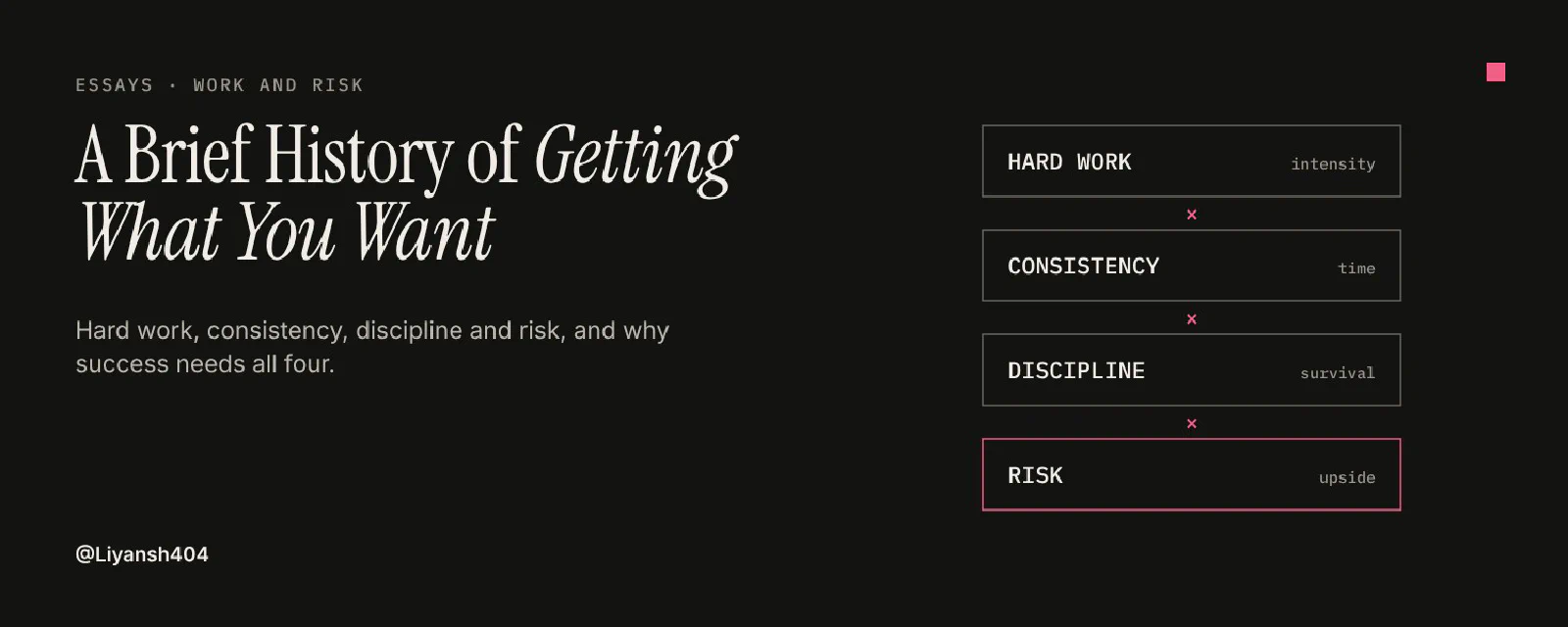
A Brief History of Getting What You Want
Hard work, consistency, discipline and risk, and why success needs all four.
In 1984, a young doctor in Perth, Australia, poured himself a drink that no sane person would touch.
It was a cloudy broth swimming with bacteria — Helicobacter pylori, cultured from a patient’s stomach. Barry Marshall was 32. He drank it anyway.
For most of the twentieth century, medicine had agreed on a simple story about stomach ulcers. They were caused by stress, spicy food and too much acid. And everybody knew that bacteria could not survive in the stomach. It was a bath of acid. Nothing could live there.
Marshall and his colleague Robin Warren thought everybody was wrong. When they said so, their paper was rejected. When they tried to prove it by infecting piglets, the piglets refused to get sick. So Marshall became the piglet.
Three days later, he felt nauseous, and his wife noticed his breath had turned foul. By the fifth day, he was vomiting. On the eighth, a camera down his throat showed a stomach inflamed and teeming with the very bacteria he had swallowed. Twenty-one years later, Marshall and Warren shared the Nobel Prize in Medicine.
Was Marshall brave, or reckless? A genius, or simply a man who refused to stop? Hold on to that question. By the end of this essay, you will see that the answer is yes — and that this yes explains more about human success than talent ever will.
The story we tell about winners
Humans are storytelling animals. We cannot look at a pile of facts without arranging them into a plot, and the plot we love most is the one about the chosen few.
For thousands of years, the chosen were chosen by the gods. A king won battles because heaven favoured him. A merchant grew rich because the stars smiled at his birth. Then the gods slowly retired from public life, and we needed a new explanation. We found one. We called it talent.
Talent is a wonderful story. It explains everything and demands nothing. If Sachin Tendulkar was simply born a genius, then the rest of us are excused. We can admire him from the sofa.
The story is not entirely false. Genes matter. So do luck, parents and the accident of where you were born. In 2014, psychologists combined 88 studies on practice and performance. Practice explained only about 12% of the differences between people — 26% in games like chess, 18% in sports, less than 1% in professions. The rest came from elsewhere.
But notice what that really means. You do not control the dice. You control how many times you get to roll them, and what you do when they land. That part is governed by four forces. None of them is glamorous. None of them is new. And here is what most motivational writing misses: they do not add up. They multiply.
Multiply anything by zero and you get zero. A genius who quits after a year scores zero. A grinder who never takes a chance scores zero. A gambler with no rules reaches zero faster than anyone. Let us take the four forces one at a time.
1. Hard work: the edge, not the hours
In a village called Khandra, in Haryana’s Panipat district, there was a twelve-year-old boy who weighed around 90 kilos and hated exercise. His family pushed him into morning jogs at the local Shivaji Stadium. There he met a javelin thrower, who handed him a spear one evening and asked him to throw. It flew 35 to 40 metres — not bad for a heavy boy who had never held one.
On 7 August 2021, that boy, Neeraj Chopra, threw 87.58 metres in Tokyo and won India’s first Olympic gold in athletics.
It is tempting to file this under hard work and move on. But hard work is the most misunderstood of the four forces. Remember that study: practice explained 18% of the differences in sports, but less than 1% in professions. Why would practice matter so little at the office?
Because most of what we call work is not practice. It is repetition. An accountant with twenty years of experience often has one year of experience, repeated twenty times.
Consider a small ritual from a Mumbai maidan in the 1980s. Coach Ramakant Achrekar would place a one-rupee coin on top of the stumps. If young Sachin Tendulkar batted through the whole session without getting out, the coin was his. He won 13 of them. Decades later, asked about his most treasured possession, Tendulkar did not name a bat signed by Don Bradman. He named the coins.
Achrekar was not paying Sachin to bat longer. He was paying him to bat under pressure, with a price on every mistake. That is the real definition of hard work: deliberately working at the edge of what you cannot yet do, with feedback that stings.
Our ancestors measured effort by sweat, because for a farmer, more hours really meant more grain. We inherited that instinct and brought it into offices, where it quietly fails us. The question is not how tired are you? The question is what can you do today that you could not do last month?
If your work never makes you feel slightly stupid, it is probably not hard work. It is just work.
2. Consistency: the force our brains cannot see
Evolution built the human brain for a linear world. On the savannah, one day of foraging bought roughly one day of food. Twice the effort, twice the berries. Nothing in that world compounded — so nothing in our instincts understands compounding.
That is why consistency feels pointless for a very long time, and then suddenly looks like magic.
Warren Buffett bought his first shares as a schoolboy. By one estimate, nearly 90% of his fortune arrived after his 65th birthday. He was not a dramatically better investor at 70 than at 35. He was simply still there. As the writer Morgan Housel put it: Buffett’s skill is investing, but his secret is time.
In February 2012, a 13-year-old in North Carolina uploaded his first YouTube video. For roughly five years, almost nobody watched. He kept uploading anyway, and spent his days studying why some videos spread and others die — “relentlessly, unhealthily obsessed,” in his own words. In January 2017, he posted a video of himself counting to 100,000. It took him about 40 hours. It went viral. Today MrBeast has more than 500 million subscribers.
Notice the irony. The video that changed his life was a video about doing one boring thing, over and over, far longer than any sane person would. It was a parable about his own career.
Or take Katalin Karikó, a Hungarian biochemist who spent decades betting on messenger RNA when almost no one else would. Her grant applications were rejected. In the 1990s, the University of Pennsylvania demoted her and cut her pay. Later she was told she was “not of faculty quality.” In 2005, she and Drew Weissman published a paper that a leading journal had at first refused to even review. Fifteen years later, it became the blueprint for the mRNA Covid-19 vaccines. In 2023, they won the Nobel Prize.
Consistency is not the same as stubbornness. Karikó kept the question constant while changing labs, collaborators and methods. Buffett kept the principles while his portfolio changed a thousand times.
The world does not reward what you do. It rewards what you keep doing.
3. Discipline: the force that keeps you alive
In 1929, as the American stock market collapsed, Jesse Livermore made about $100 million by betting against it — billions in today’s money. He was perhaps the greatest speculator of his age. He had rules, and he preached them: cut losses fast, never add to a losing position, never trade on someone else’s tip.
He also had a habit of breaking them. Years earlier, he had lost a fortune on cotton by doing exactly what his rules forbade — taking advice from others and pouring money into a losing trade. By 1934, five years after his greatest triumph, he was bankrupt again. In 1940, his fortune gone, he took his own life.
Livermore did not lack talent. He did not lack hard work or courage. He lacked the third force. And in markets, as in life, one rule stands above all others: you must survive to play the next round.
We usually imagine discipline as heroic willpower — the child staring at a marshmallow, refusing to eat it. In the famous Stanford experiments, the children who waited seemed to do better in life. But in 2018, a much larger study of over 900 children found the link far weaker; once family background and early abilities were accounted for, it largely faded away.
A different study tells us more. Researchers in Germany pinged 205 people seven times a day for a week, asking about their desires and temptations. The people with the most self-control did not resist temptation more often. They simply faced fewer temptations in the first place.
That is the secret most of us miss. Disciplined people are not better at fighting themselves. They are better at arranging their lives so the fight never starts.
The novelist Haruki Murakami describes his routine like this: “When I’m in writing mode for a novel, I get up at four a.m. and work for five to six hours.” In the afternoon he runs ten kilometres or swims fifteen hundred metres. He goes to bed at nine. “The repetition itself becomes the important thing,” he says. “It’s a form of mesmerism.”
Murakami does not decide every morning whether to write. The decision was made years ago. For a trader, the same idea has a duller name: a stop-loss, written down before the trade, not during it.
Talent decides how high you can climb. Discipline decides whether you fall.
4. Risk: the blank space on the map
In 1981, Sudha Murty had ₹10,250 in savings. Her husband, N. R. Narayana Murthy, wanted to start a software company with a few friends. His previous venture, Softronics, had failed. She kept ₹250 for herself and gave him the rest. “He failed in his earlier venture,” she later said, “so I took a risk.”
That ₹10,000 became Infosys, a company worth around $50 billion today.
Here is the paradox. Hard work, consistency and discipline are all ways of reducing randomness. Risk is the decision to invite it in. Without risk, the other three forces still produce something — but something small. An excellent employee building someone else’s dream. A careful saver who never invests. A brilliant scientist who never questions the textbook.
In Sapiens, Yuval Noah Harari points to a quiet shift around 1500. For centuries, maps had been filled with confident drawings of places nobody had visited. Then European mapmakers began leaving blank spaces — admitting we do not know what is here. That admission, Harari argues, helped turn Europeans into explorers. Every discovery since has needed someone willing to walk into the blank space.
But look closely at how successful people walk in. They are not gamblers. Before Barry Marshall drank his bacteria, he had his stomach scoped so he could compare before and after, and he knew the infection could be treated. Sudha Murty risked her savings, not the roof over her family’s head. Both bet what they could afford to lose on something they could not afford to miss.
That is the shape of a good risk: a survivable downside and an enormous upside. Livermore had the same courage with the opposite shape. He bet everything, again and again, until the one time it did not come back.
Take risks you can survive. Never take one you cannot.
Why one force is never enough
Each force, on its own, turns into a trap. Remove any one of them and you get a familiar character — someone you probably know. Possibly someone you are.
| Missing force | Who you become |
|---|---|
| Hard work | The dabbler. Always starting, never good. Ten years of showing up to do the same easy things. |
| Consistency | The sprinter. Brilliant for three weeks, burnt out by the fourth. Every year begins with a new plan. |
| Discipline | The gambler. Rich on Monday, ruined on Friday. Livermore, again and again. |
| Risk | The safe pair of hands. Skilled, reliable, respected — and quietly building someone else’s dream. |
Now, an honest warning, because you deserve one.
During the Second World War, the American military studied bombers returning from missions and mapped where they had been hit by bullets. The obvious plan was to add armour where the holes were. The statistician Abraham Wald pointed out the flaw: these were the planes that came back. The planes hit in the engines never made it home. The armour belonged where the holes were missing.
Every story in this essay is a returning plane. For every Barry Marshall, there were scientists who defied the consensus and were simply wrong. For every Infosys, there were countless Softronics — including Murthy’s own. The four forces do not guarantee success. Nothing does.
What they do is change the odds. They keep you in the game long enough, and good enough, and open enough, that when luck finally walks past, it finds you standing there.
The four forces will not make you lucky. They will make you the kind of person luck can find.
Back to the man with the glass
So, was Barry Marshall brave or reckless? A genius, or a man who simply would not stop?
Look at his story again, slowly.
Before anyone believed him, Marshall and Warren made many fruitless attempts to grow the bacteria in their lab. That is hard work. The breakthrough finally came over Easter 1982, when culture plates were left in the incubator by mistake for the long weekend. That is luck — arriving, as it usually does, for someone already standing at the bench. When their paper was rejected and the piglets stayed healthy, they kept going. That is consistency. Before he drank, Marshall had his own stomach examined, so the experiment would prove something rather than merely hurt. That is discipline. And then he lifted the glass. That is risk.
Four forces. One glass.
You will probably never drink a beaker of bacteria. But somewhere in your life, a glass is waiting. It might be a channel with nine subscribers. A trading journal. A business plan your family thinks is foolish. A question in your field that everyone “knows” the answer to.
If you bookmark one thing from this essay, make it these four questions. Ask them every Sunday.
- Hard work: What can I do this week that I could not do last month?
- Consistency: Will I still be doing this in five years — even if nobody notices until then?
- Discipline: Which decision have I already made, so that I never have to make it again?
- Risk: What bet am I avoiding — and could I survive losing it?
Humans will keep telling stories about winners. We will keep calling it talent, or destiny, or luck.
But talent is a story other people tell about you. These four forces are the story you get to write yourself.
Sources
- Barry Marshall — Wikipedia and the 2005 Nobel ceremony speech
- Macnamara, Hambrick & Oswald, 2014 — Association for Psychological Science
- Neeraj Chopra — Wikipedia and The Better India
- Sachin Tendulkar’s 13 coins — The Better India
- Buffett’s wealth after 65 — Jason Zweig and Morgan Housel
- MrBeast — Wikipedia
- Katalin Karikó — The Chronicle of Higher Education
- Jesse Livermore — CFI.co
- Marshmallow test replication, Watts et al. 2018 — HCPLive
- Hofmann et al. on everyday temptations — Chicago Booth Review
- Haruki Murakami, Paris Review interview (2004) — quoted on brandur.org
- Sudha Murty on the ₹10,000 — Business Standard
- Infosys market cap — CompaniesMarketCap (as of 25 Oct 2026)
- Harari’s maps with blank spaces in Sapiens — LitCharts
- Abraham Wald and the bombers — We Are The Mighty